
Course Interaction
Completion requirements
Key Takeaways
1. An online course could be designed to provide intentional opportunities for students to interact with the instructor, each other, and the course content.
2. The Community of Inquiry Framework provides a model for finding an optimal balance between teaching, social, and cognitive presence.

Student and faculty interaction are essential quality indicators in an online course setting. Course interaction can be organized into three categories: student-to-student, instructor-to-student, and student-to-content interactions. Instructor-to-student interactions can be achieved online with class discussions, daily or weekly multimedia announcements in the LMS, synchronous meetings, virtual office hours, and providing substantive feedback.
The Community of Inquiry framework, a model that has been used significantly in online and blended education, highlights the importance of three interdependent elements that facilitate successful learning experiences: social presence, teaching presence, and cognitive presence.
When engaged in Emergency Remote Teaching, the most important thing is to ensure that interaction opportunities are available, and that there are regular interactions with students. Basic tools in Moodle allows us to do this in ways that are simple and already familiar to many students and faculty.
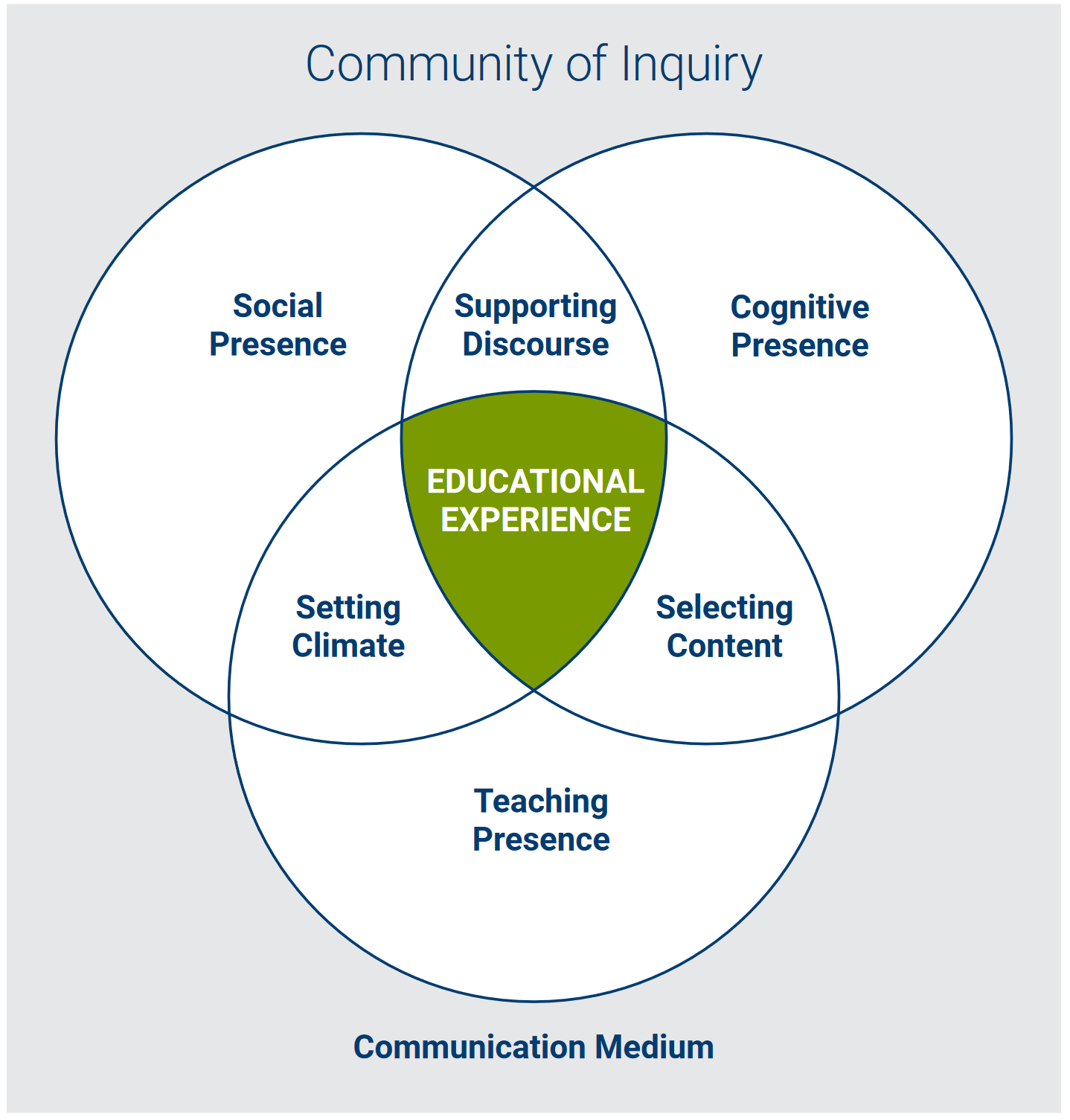
Source: Community of Inquiry
Beginner
Establish instructor presence with Moodle tools such as announcements and discussion forums.
Facilitate effective online discussion activities to foster student-to-student and instructor-to-student interaction.
Intermediate
Implement online course activities that include student collaboration and group work.
Last modified: Monday, July 6, 2020, 2:50 PM